In 2026, choosing a mobility aid for a narrow doorway requires more than checking product popularity. A device may look compact online but feel awkward beside a bathroom frame. Every inch matters. Door width, turning space, user strength, and flooring can change the safest choice. This guide examines canes, narrow walkers, rollators, transport chairs, and compact wheelchairs for homes with limited clearance.
What are the best mobility aids for narrow doorways? The honest answer depends on the person and the space. A slim rolling walker may pass through a 28-inch doorway, yet its wheels could catch on a raised threshold. A narrow wheelchair may fit the opening but leave too little room for comfortable hand movement. These details are easy to miss. I have found that measuring the doorway at its tightest point, including trim and hinges, prevents expensive mistakes.
This article uses practical fit checks, manufacturer specifications, and guidance commonly considered by occupational therapy professionals. It also explains braking, seat width, turning radius, weight capacity, and indoor maneuverability. Product labels are not always perfectly consistent, so measurements should be verified before purchase. A device that works in one apartment may fail in another. That uncertainty deserves attention. Readers should also ask a qualified healthcare professional or mobility specialist to assess posture, balance, and transfer safety. The best aid is not simply the smallest one; it is the device that supports confident movement without creating new hazards.
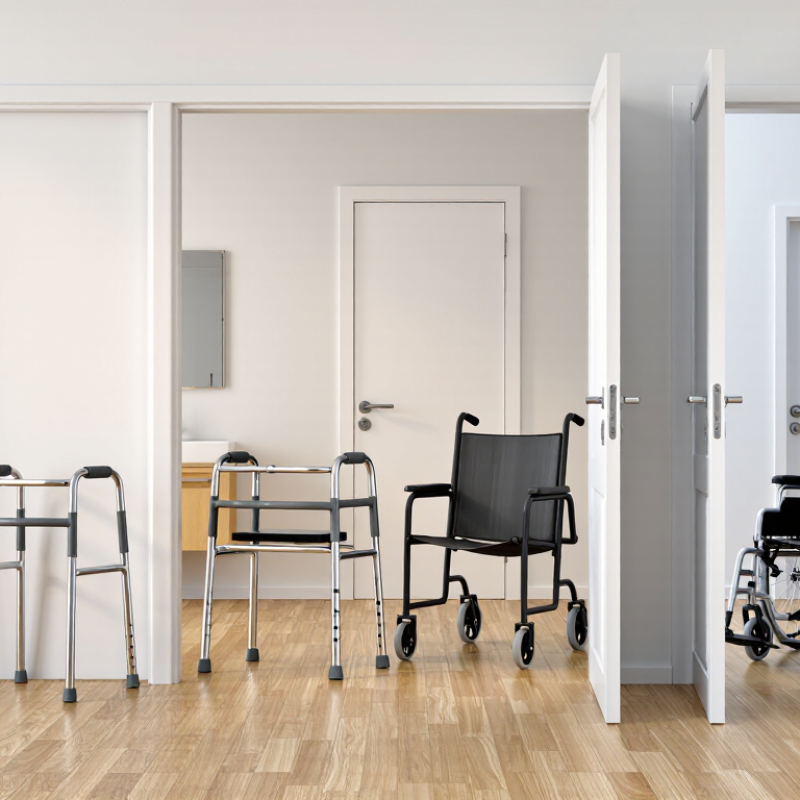
2026 Best Mobility Aids for Narrow Doorways?
Doorway Measurements: ADA’s 32-Inch Minimum Clear-Width Benchmark
The 2010 ADA Standards require at least 32 inches of clear doorway width. This measurement applies when the door opens 90 degrees. Measure between the door face and the frame stop, not across the door slab. That detail often causes mistakes.
A narrow doorway can turn a basic transfer into a risky maneuver. Measure with the mobility aid in its widest operating position. Include hand rims, wheels, footrests, and the user’s hands. A folding aid may fit through 32 inches, yet still leave little room for turning or correcting direction. In field checks, I would also measure the threshold. Even a small raised edge can catch a front caster.
Think beyond the minimum.
The World Health Organization and UNICEF reported in 2022 that more than 2.5 billion people need at least one assistive product. That figure may exceed 3.5 billion by 2050. Their findings reinforce a practical point: access needs are not rare or temporary. The U.S. Centers for Disease Control and Prevention also reports that about one in four adults has a disability.
The 32-inch benchmark is a legal accessibility reference, not a comfort guarantee. A wider opening can improve control, especially when backing out. I would test the actual aid, user, and doorway together. My own measurement process is not flawless; furniture, hinges, and poor lighting can change the result. Recheck everything before choosing equipment or altering the opening.
| Mobility Aid Type | Typical Overall Width | Clearance Inside a 32-Inch Doorway | Narrow-Doorway Suitability | Important Measurement or Use Consideration |
|---|---|---|---|---|
| Single-Point Cane | Approximately 4–8 in | About 24–28 in per side when centered | Excellent | Usually passes through narrow openings easily; verify that the user can maintain balance while operating the door. |
| Forearm or Underarm Crutches | Approximately 18–24 in, depending on gait and adjustment | About 8–14 in total side clearance | Excellent to Good | The user’s elbow position, crutch angle, and hand placement can require more space than the equipment’s static width. |
| Hemi-Walker | Approximately 20–24 in | About 8–12 in total side clearance | Good | Measure the widest point, including rear legs and handgrips; a straight approach is easier than an angled entry. |
| Standard Folding Walker | Approximately 23–26 in | About 6–9 in total side clearance | Good | The frame may need to be lifted or turned during entry; check whether the user can manage the threshold safely. |
| Four-Wheel Rollator | Approximately 22–26 in | About 6–10 in total side clearance | Good | Brakes, rear wheels, and a seat can increase the effective width; confirm the width at the widest point. |
| Transport Wheelchair | Approximately 21–24 in | About 8–11 in total side clearance | Good | A helper generally propels the chair; account for footrests, hand rims, anti-tip devices, and the door swing. |
| Manual Wheelchair | Approximately 24–28 in | About 4–8 in total side clearance | Generally suitable; verify carefully | Measure the complete chair, including hand rims, footrests, tires, and camber; propulsion and turning space may be limiting factors. |
| Narrow-Frame Manual Wheelchair | Approximately 20–24 in | About 8–12 in total side clearance | Good | Often easier to pass through a narrow opening, but the user still needs adequate approach, turning, and transfer space. |
| Three-Wheel Mobility Scooter | Approximately 22–27 in | About 5–10 in total side clearance | Conditionally suitable | A 32-inch opening may permit passage, but turning radius, tiller position, threshold height, and door maneuvering can be restrictive. |
| Four-Wheel Mobility Scooter | Approximately 24–30 in | About 2–8 in total side clearance | Conditionally suitable to limited | Some models may pass, but the scooter’s turning envelope and control tiller commonly require more room than the static width suggests. |
Widths shown are typical planning ranges rather than universal specifications. Always confirm the exact manufacturer-listed overall width, accessories, door hardware, threshold height, approach space, and the user’s ability to open and close the door safely.
A standard wheelchair is often 24 to 27 inches wide. Hand rims, locks, and footrests may add extra inches. Measure the widest point.
Walkers commonly measure 20 to 25 inches across. Rollators often measure 23 to 27 inches. Their seats, wheels, and baskets affect width.
A 32-inch clear opening is a useful accessibility reference. Measure between the open door and the opposite frame. Do not measure the frame’s outside width.
Not always. A device may fit straight through but scrape the wall during a turn. Approach angle, footrests, handles, and nearby furniture matter.
Leave about 2 inches on each side when possible. More space feels safer, especially during angled approaches. Tight gaps can cause hesitation.
No. It is a helpful planning reference, not a universal answer. Door trim, furniture, thresholds, and wall objects can reduce usable space quickly.
Folding walkers, narrow-frame walkers, and pivoting designs may help. Folding models support storage and transport. Narrow frames often provide better indoor control.
Test the actual doorway, hallway, floor surface, and turning area. Release the brakes, then carry a small bag. Small problems appear quickly.
Handles should support an upright posture and controlled steps. Low handles may strain the back. High handles may reduce control. A qualified specialist can check the fit.
Focusing only on width is one mistake. I once underestimated turning space. Furniture changes can also ruin an earlier measurement. Recheck the route.
Choosing the right mobility aid for a narrow doorway begins with accurate measurements and practical clearance planning. The ADA’s 32-inch minimum clear-width benchmark provides a useful reference, but users should also measure door frames, hinges, thresholds, and nearby obstacles. Wheelchairs, walkers, and rollators vary in width and maneuverability, so comparing their dimensions is essential. Adequate turning space also matters, with a 60-inch wheelchair turning circle serving as a helpful planning guideline where room allows. What are the best mobility aids for narrow doorways? In many situations, folding, narrow-frame, or pivoting designs offer greater flexibility without sacrificing stability.
Safety should remain the top priority. A suitable aid must provide dependable balance, comfortable handling, secure brakes, and enough clearance for the user’s body and hands. Before purchase, test the equipment through the actual doorway and evaluate turning, reversing, and threshold crossing. Reviewing performance against relevant ISO 7176 mobility-aid standards can further support informed decisions, while professional assessment may help match the device to the user’s strength, posture, and daily environment.

 Iowa Medical